Curriculum Overview
TEACHING AND LEARNING
The staff of Frithwood Primary School are committed to raising standards and providing the best education for the pupils in school. The Teaching and Learning policy seeks to identify the features of effective teaching which translates the aims of the school and the curriculum into relevant, challenging and enjoyable learning experiences for all pupils.
CURRICULUM AT FRITHWOOD
The curriculum at Frithwood follows the EYFS Curriculum for Nursery and Reception and the National Curriculum for Years 1 -6. In addition to the following the National Curriculum programmes of study, we use a range of resources and schemes of work to deliver the curriculum and these include:
Phonics: Read, Write Inc.
Science: PlanBee
Computing: Purple Mash
PSHE: SCARF
RE: LA agreed syllabus.
Music: Charanga
French: Rigolo
Our curriculum is further tailored to meet our requirements by a range of additional elements and these include:
Curriculum Weeks: which allow us to focus on a particular subject or theme in more detail over a whole week.
Year Group Assemblies: All year groups perform a whole school assembly for pupils and parents each year on an a range of curriculum areas.
Phase Group Performances: Each Year we have the following performances to pupils and parents:
-EYFS Christmas performance
-KS1 Christmas performance
-Y3/Y4 Spring term concert
-Y5/Y6 Summer term performance
Life Bus Week: Each year we have a visit from the Life Bus which delivers a range of interactive PSHE lessons to every class.
Outdoor Learning: Each class will have termly outdoor lessons on a range of curriculum areas using the Jubilee Building as a base.
Writing For Real: Each year we have a Writing For Real week where an area of the school is 'set up' with a wide range of props to produce a stimulating scene to encourage the children's creative writing.
Class Trips and Workshops: Each class will have at least two class trips or visiting workshops each year.
Sports Week: including Sports Day and inter-class/year competitions.
Links with Northwood School, Northwood College & St Johns School: Opportunities for pupils to take part PE/Drama/Dance/Science/DT activities.
Celebrating Cultural Festivals: e.g. Chinese New Year, Divali, Ramadan, Eid, Christmas, Hannukah
Links with Emmanuel Church: to celebrate Harvest and Christmas.
Safer Internet Day
Black History Month
Anti-Bullying Week
Road Safety Workshops
Junior Citizen: Y6
Wales Residential Trip: Y6
Bikeability: Y6
THE EARLY YEARS FOUNDATION STAGE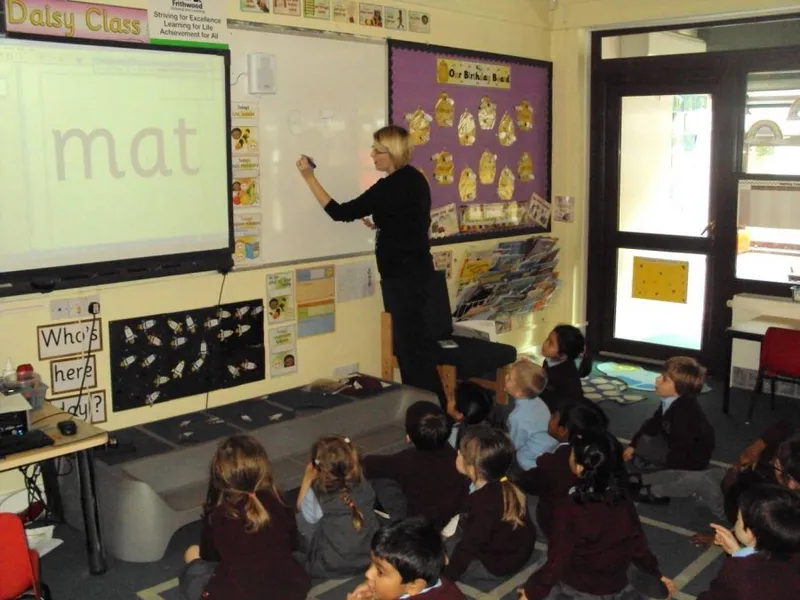
At Frithwood we believe that every child deserves the best possible start to their school life and we strive to give all our children the support that enables them to fulfil their potential. We aim to ensure that all our pupils learn and develop well and are kept healthy and safe. The Foundation Stage is a vital time in which our children settle into school life and are supported to become happy, confident, independent learners. We promote teaching and learning to give children the broad range of knowledge and skills that provide the right foundation for good future progress through school and life.
Our EYFS environment comprises a bright, open Nursery, two Reception classrooms with a shared conservatory area to supplement the indoor space, and two recently refurbished and highly stimulating outdoor areas. Purposefully planned, playful activities and first hand experiences are the key to learning, laying the foundations for the Early Years Foundation Stage Curriculum. We provide an appropriate balance of adult-led and child-initiated activities, depending on the children’s age and stage of development and we endeavour to prepare them for the National Curriculum which starts in Year 1.
SMSC - Spiritual, Moral, Social and Cultural
At Frithwood School we recognise that the personal and emotional development of the child is as important as academic success. Through SMSC (spiritual, moral, social and cultural) education we aim to provide opportunities for pupils to explore and develop their own values and beliefs, spiritual awareness, high standards of personal behaviour and a caring attitude to others.
Pupils’ spiritual development involves the growth of their sense of self, their unique potential and an appreciation of their strengths and weaknesses. They develop the knowledge, skills and attitudes they need to understand their own well-being.
Pupils’ moral development involves them understanding the difference between right and wrong and of moral conflict. They develop a concern for others and are able to reflect on the consequences of their actions. They acquire the knowledge they need in order to make responsible and moral decisions.
Pupils’ social development involves them understanding their rights and responsibilities within different communities; school, family and the wider world. They display a sense of belonging and a willingness to participate with others. They develop the skills and understanding they need to make an active contribution, both locally and globally.
Pupils’ cultural development involves them acquiring an understanding of cultural traditions and an ability to appreciate a variety of experiences. They respect their own and others’ culture and show curiosity about the differences. They develop skills and knowledge they need in order to appreciate and contribute to culture.


